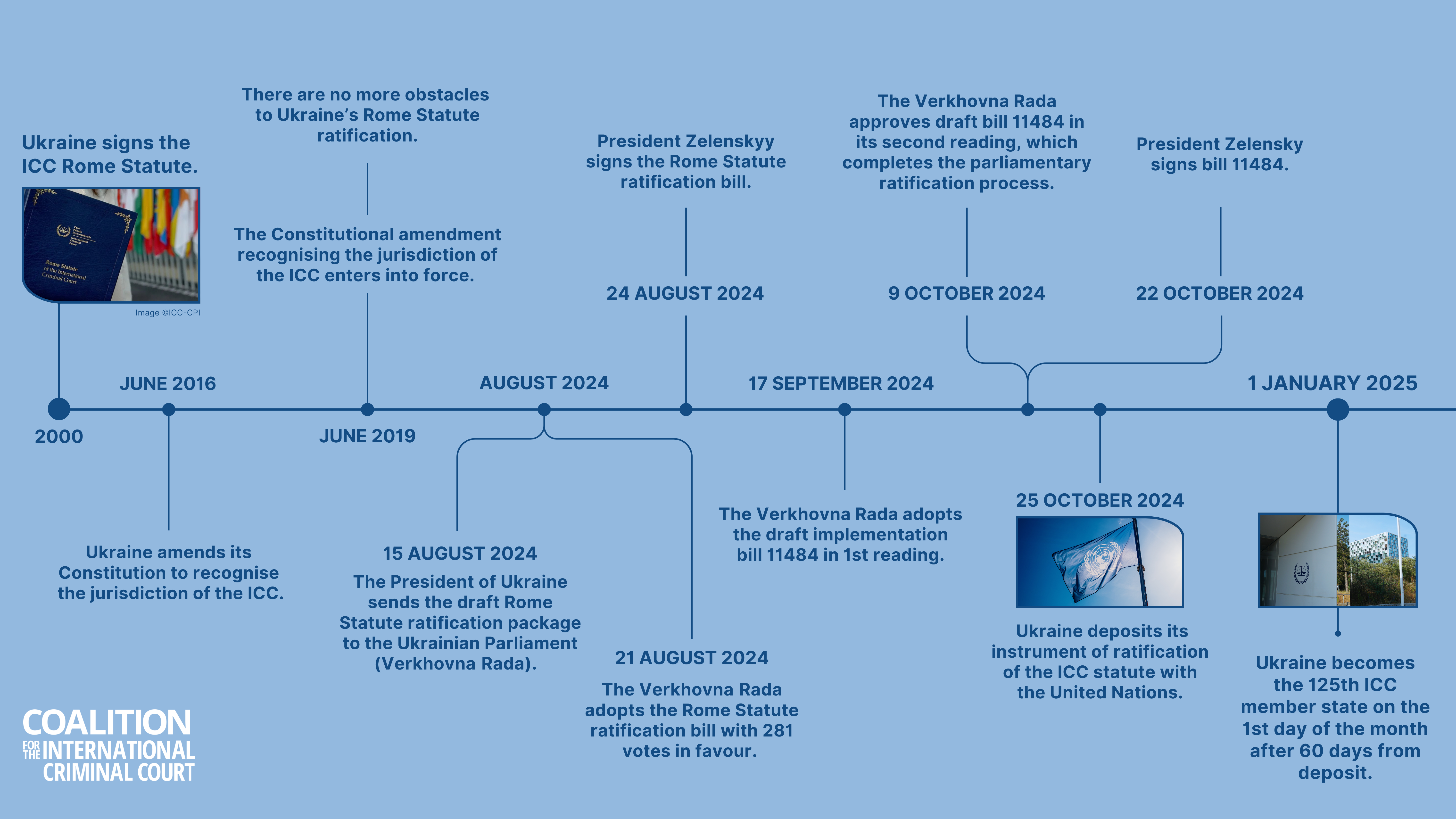
On 25 October 2024, Ukraine deposited the instrument of ratification of the ICC Statute with the United Nations. Ukraine became the 125th ICC State Party on 1 January 2025 when the ICC founding treaty, the Rome Statute, entered into force for Ukraine.
Ukraine signed the Rome Statute on 20 January 2000. The ratification process was suspended in 2004 when the Ukraine Constitutional Court considered the treaty incompatible with the Constitution. In 2016, Ukraine amended its Constitution to recognise the jurisdiction of the ICC, but no concrete step was taken until August 2024. On 15 August 2024, the Office of the President of Ukraine submitted a package of laws for the ratification of the Rome Statute and its amendments to the Ukrainian Parliament (Verkhovna Rada).
On 24 August 2024, the President of Ukraine, Volodymyr Zelenskyy, signed the “Law on the Ratification of the Rome Statute of the International Criminal Court and its amendments” into law after its adoption by the Verkhovna Rada on 21 August 2024, paving the way for Ukraine to join the ICC Statute. The domestic ratification process required the adoption of a separate implementation bill, “Draft Law on Amendments to the Criminal and Criminal Procedural Codes of Ukraine in connection with the ratification of the Rome Statute of the International Criminal Court and its amendments” (draft bill 11484), that was submitted together with the ratification bill. On 22 October 2024, following its adoption by the Ukrainian Parliament, President Zelenskyy signed Bill 11484), into law, thus completing the domestic ratification process.
On 25 October 2024, Ukraine’s representatives deposited the instrument of ratification of the ICC Statute with the United Nations. The Rome Statute enters into force for the State on the 1st day of the month after 60 days following the deposit (Article 126 of the ICC Statute).
With the Rome Statute ratification instrument, Ukraine also deposited a declaration on the use of article 124 of the Rome Statute that “for a period seven years after the entry into force of the Rome Statute for Ukraine, it will not accept the jurisdiction of the International Criminal Court regarding crimes referred to in Article 8 (as amended), when it is likely that the crime was committed by its nationals’.”. It is the first time that a State has uses Article 124 in this manner. Article 124 of the Rome Statute was included in the Statute in 1998 as a transitional provision, and has not been used since the adoption of the Rome Statute, before the ICC-ASP decided, in 2015, by consensus to amend the Rome Statute in order to delete Article 124 and urged future States Parties not to make use of article 124.
The Coalition for the ICC and is members in Ukraine have held numerous campaigns and awareness raising activities in the country. The Coalition for the ICC welcomes Ukraine’s ICC membership as a crucial signal at a time the Court has come under further threats and sanctions by several actors including States not party to its Statute.

Photo credit: Ukrainian Legal Advisory Group
In order to fully support the Rome Statute principle of complementarity, Ukraine should now work towards full harmonisation of Ukrainian domestic legal framework with the Rome Statute and international criminal and humanitarian laws. Law 11484 “on Amendments to the Criminal and Criminal Procedural Codes of Ukraine in connection with the ratification of the Rome Statute of the International Criminal Court and its amendments” incorporates some of the Rome Statute’s provisions into national law. The passing of legislation harmonising Ukrainian domestic laws with the Rome Statute’s definitions and principles will better position Ukraine to carry out its primary responsibilities to bring justice for Rome Statute crimes through credible national investigations and prosecutions.
As of 1 January 2025, Ukraine will participate as a member state in the ICC Assembly of States Parties (ICC-ASP). As a fully-fledged member in the Assembly of States Parties (ASP), Ukraine can contribute actively towards the discussions and outcomes of the work of the Assembly. The Assembly of States Parties is the ICC’s management oversight and legislative body. It provides the ICC with oversight and takes decisions on issues of importance for the success of the Court, such as election of officials, its annual budget, matters of cooperation and non-cooperation, complementarity and amendments the Rome Statute and other rules.
Ukraine has already recognized the role that the ICC can play in addressing impunity by accepting the jurisdiction of the Court over alleged crimes committed on its territory from November 2013 onward, using article 12(3) of the Rome Statute. On the basis of these declarations, between April 2014 and December 2020, the situation in Ukraine was under preliminary examination by the Office of the Prosecutor. In 2022, the ICC prosecutor opened an investigation into the situation in Ukraine and to date, the court’s judges have issued arrest warrants against six individuals including against Mr. Vladimir Putin, President of the Russian Federation.
CIVIL SOCIETY REACTIONS #NGOVoices:
The Coalition for the International Criminal Court (CICC) congratulates Ukraine on this important and long-awaited step. “Ukraine’s ratification is an important commitment that the suffering of victims will not be ignored, as well as of the continuous support by States for the ICC and the global effort to end impunity at a time when the Court is under new threats and sanctions.” stated Virginie Amato, CICC Advocacy Director. “We now call on Ukraine to fully harmonise its domestic legal framework with the Rome Statute and international criminal law, to strenghten its primary responsibilities to bring justice for Rome Statute crimes through credible national investigations and prosecutions.”
“The ratification of the Rome Statute is an event of historical significance. It means that Ukraine accepts as an axiom: international crimes must be punished” highlighted Oleksandra Matviichuk, head of the Center for Civil Liberties. “The ratification of the Rome Statute should serve as a catalyst for comprehensive changes to Ukrainian legislation. The Criminal Code and other normative acts must align with international humanitarian and criminal law. Moreover, Ukrainian investigators, prosecutors, and judges must be equipped with the appropriate legal tools to combat impunity.”
Crimea SOS welcomed the ratification of the Rome Statute as “a long-awaited triumph of human rights defenders who had been actively advocating this essential step over the last 10 years”. Ievgeniy Iaroshenko, Analyst at Crimea SOS, stressed that it is paramount for Ukraine to lift “jurisdictional limitations regarding the crime of aggression. It is paramount to [Ukraine] to prosecute Russian and Belarussian leadership given that the crime of aggression has become a root cause of other international crimes committed by Russian troops and officials on Ukraine’s territory or against Ukrainian nationals. This may also have a potential to become a breakthrough amendment in terms of discouraging other states from acts of aggression.”
Roman Romanov, Human Rights and Justice Program Director at the International Renaissance Foundation (IRF), emphasised how “civil society groups, prioritizing the interests of victims, have done enormous advocacy work to have final decision made” culminating in the ratification of the Rome Statute.
“This milestone brings Ukraine closer to attaining justice for the victims of international crimes committed by the Russian Federation. The ratification fosters trust in the justice system among civil society, offering victims a stronger foundation to pursue justice, recognition, and the satisfaction they rightfully deserve”, reflected Kseniia Korniienko, Lawyer at the Regional Center for Human Rights.
Ratification “shows that Ukraine, not only in theory but also via practical steps, supports international justice architecture and adheres to the values enshrined in the Rome Statute. For victims this step means that while with some delays, Ukraine can keep up with its promises”, stated Dmytro Koval, Со-Executive Director of Truth Hounds. “We hope that with the ratification (even with article 124 caveat) there will be less excuses for not execution of the International Criminal Court’s warrants. We also hope that Ukraine will play a prominent role in further developing the Rome Statutes, be it in the review of the jurisdictional clause of the crime of aggression or the inclusion of ecocide as a fifth international crime.”
“Among the hopes the future positive changes is the possible withdrawal of the reservation under Article 124 of the Rome Statute, which was made during the voting on the ratification law in the Verkhovna Rada of Ukraine, which looks rather strange given the position of Ukraine, which has established constant daily cooperation with the Office of the ICC Prosecutor and consciously adheres to internationla humanitarian law”, stressed Oleksandr Pavlichenko, Executive Director of the Ukrainian Helsinki Human Rights Union (UHHRU).
“While it is critically important to manage victims’ expectations, full access to the ICC gives hope for justice to those who have suffered most serious violations in one of the most brutal wars in recent world history”, underscored Nadia Volkova, Director of the Ukrainian Legal Advisory Group (ULAG). “Although it will be another long and challenging process, [the] hope is that by implementing the Rome Statute into domestic legislation, the capacity of Ukrainian authorities will be strengthened so that it will benefit the majority of victims and survivors who may not have their case heard by the ICC.”
“Following the ratification, we anticipate further strengthening of Ukraine’s cooperation with the International Criminal Court, which will contribute to more effective investigations of crimes, particularly sexual and gender-based violence”, highlighted Daria Rosokhata, Legal Analyst at the Ukrainian Women Lawyers Association “JurFem”. “At the same time, it is crucial to ensure access to justice for survivors and to integrate international standards into the national legal system. However, we acknowledge that this path will not be without challenges. These challenges may include the process of adapting legislation to ICC standards (notably, recent amendments to Ukraine’s Criminal Code and Criminal Procedure Code following the ratification have sparked debates among practitioners) and securing funding to support national and international mechanisms (including training for the legal community).”